Copyright by viettperson. Powered by Blogger.
HDMovieClub - Contact: 0907.247.545 ..............................................................................................................................................................................Bayern Munich vs Chelsea ............New Movie............New Drama ............ Phim HongKong ............ Phim TVB ............ Phim Mỹ ............ Phim Nhật ............ Phim Bộ Hàn Quốc ............ Phim Việt Nam............ Phim Thái Lan ............ Phim Châu Tinh Trì ............ Phim Thành Long
Showing posts with label Golden-headed Langur. Show all posts

The Cat Ba Langur ( An Extraordinarily Beautiful Primate )

Thursday, 1 December 2011

Identification of the Cat Ba Langur
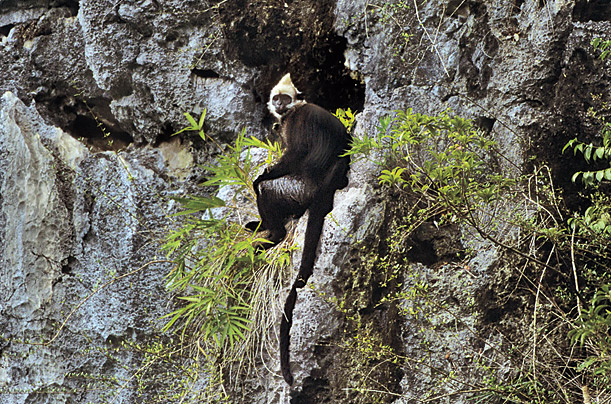
As indicated by this species former name (the Golden-headed langur), head and neck down to the shoulders are bright golden to yellowish-white, with the head and the crest being most brightly coloured. The rump and the extremities of adult males and females of the Cat Ba langur are covered by dark chocolate brown, almost black fur. A grey band runs from the thighs to the back, forming a V-shape above the tail root and long hair of the back forms a shoulder cape. Another prominent feature of all Trachypithecus langurs is their long tail. Its length clearly exceeds head-body length.


The only difference in the colouration between the sexes is a white pubic patch on the female. The infant coat colouration of the Cat Ba langur as well as of the other Trachypithecus species in Vietnam is a flamboyant orange.

Distribution of the Cat Ba Langur and Ecology
The only known locality of where this langur occurs is the island of Cat Ba. There is no evidence that the Cat Ba langur ever inhabited the mainland. Immigration of this species onto Cat Ba Island might have taken place long before the sea level rose due to a melting of glacial ice. The last time this melting happened was some 10,000 years ago and it turned the former mountainous Ha Long Bay into a huge Archipelago.

The Cat Ba langur along with two of its close relatives, the Francois’ langur (Northern Vietnam and Southern China) and the White-headed (Southern China), are closely associated with limestone areas. These langur species prefer Karst and forest on limestone as habitat and regularly sleep in caves throughout the year. Scientists suggest that caves and cracks are important as shelter against unfavourable weather conditions. One langur group usually has several (up to 12) different resting caves. The group spends only 1-2 nights in the same cave before moving on to other feeding and sleeping places.

A significant proportion of a langurs’ daily life is devoted to foraging and resting. The diet of the Cat Ba langur mainly consists of leaves, but also includes fresh shoots, flowers, bark and some fruits that are not palatable to human beings. Most of the langur’s food has very high concentration of fibre and tannic acids, and often contains substances that would be poisonous to other animals, including human beings.

Threat Status
The World Conservation Union (IUCN) lists the Cat Ba langur as one of the most critically endangered primate species of the World, due to its small population size and restricted range. Only 65 langurs currently survive in the wild whilst an additional two live in the Endangered Primate Rescue Centre at Cuc Phuong National Park.
In the past, poaching constituted the primary threat to langur survival and resulted in a population decline from estimated 2,500-2,800 individuals in the 1960s, to a mere 53 individuals by 2000.

As a result of this steep decline in numbers, the remaining langur population is now highly fragmented and low reproductive output threatens their future survival. The population of the Cat Ba langur is subdivided into seven isolated sub-populations. Some of these include all-female groups and are therefore non-reproducing social units. Langurs were mainly poached for the preparation of traditional medicine, referred to as “monkey balm”, and only rarely for use as food, as their meat has a very unpleasant smell.

Golden-headed Langur

The golden-headed langur, Trachypithecus p. poliocephalus, is probably the most endangered of the Asian colobines. This species only occurs on the Island of Cat Ba in the Gulf of Tonkin, northeastern Vietnam. The Cat Ba Archipelago is in the world-famous Ha Long Bay, a spectacular karst formation that was invaded by the sea. The golden-headed langur inhabits tropical moist forest on limestone karst hills, and shares this habitat preference with the six to seven taxa of the T. francoisi group. Among these so called karst langurs, the Cat Ba langur and its closest relatives, the white-headed langur, T. p. leucocephalus Tan, 1955, in southern China, and the wide-ranging Francois’ langur, T. francoisi (Pousargues, 1898), the northernmost representative of the genus, display the strictest behavioral adaptations to their karst habitat.

There are no systematic and reliable data available on the historic density of the langur population on Cat Ba Island. According to reports of indigenous people the entire island of Cat Ba (140 km²) and some smaller offshore islands were previously densely populated by langurs. Hunting has been the sole cause for the dramatic and rapid population decline from an estimated 2,400–2,700 in the 1960s to only 53 individuals by 2000. The langurs were poached mainly for trade in traditional medicines. Since the implementation of strict protection measures towards the end of 2000, the langur population on Cat Ba Island increased to a current 65 individuals (+22.5%).

Although the growth of the population is encouraging, the overall status of the species is most critical. As a result of habitat fragmentation, the remaining population is now divided into seven isolated sub-populations, five of which include or consist of all-female groups, thus non-reproducing social units. The estimated effective population size is 29 individuals at most. Only three groups are currently reproducing, and the total reproductive output in this species is accordingly low. Since a peak in births in 2003, the reproductive output of the Cat Ba Langur has stagnated at 1-2 offspring per year.

Cat Ba Island and the surrounding area are nationally and internationally recognized for their importance to biodiversity conservation. Cat Ba National Park was established in 1986. It presently covers more than half of the main island. The Cat Ba Archipelago (some 1500-2000 large and small islands, cliffs and rocks) was designated a UNESCO Man and Biosphere Reserve in 2004.

Despite this, nature and wildlife protection on Cat Ba Island is deficient. Efforts to effectively conserve the langurs and their habitat face major obstacles because of the lack of partnership and commitment with the local communities and the need to better address their aspirations for development, and due to the steadily increasing human population, besides persistent, severe deficiencies in law enforcement. As elsewhere in the region, poaching is driven by increasingly attractive commercial gains in satisfying the immense local and regional demand for wildlife. The strictest protection regime possible is necessary for the survival of all the mammals and other species on Cat Ba that are, like the langurs, targeted by the Asian wildlife trade.

A conservation program for the golden-headed langur on Cat Ba was initiated in November 2000 by the Zoologische Gesellschaft für Arten- und Populationsschutz (ZGAP), München, in cooperation with Allwetterzoo, Münster, Germany. The aim is to provide for their protection, reduce population fragmentation, and contribute to the conservation of the biodiversity on Cat Ba Island in collaboration with Vietnamese authorities.
 
Support : Creating Post Copyright © 2011. HDmovie-club, HD Movie, HD Movies, Movie, Movies, - All Rights Reserved
Proudly powered by Blogger